
Chemistry
What cetoleic acid is.
Cetoleic acid is a 22-carbon monounsaturated fatty acid with a single double bond at the eleventh carbon from the methyl end, written C22:1 n-11. That n-11 position is what makes it an omega-11 fatty acid, a different family from the omega-3s EPA and DHA, whose first double bond sits at the third carbon.
Because it is monounsaturated, cetoleic acid is comparatively stable, unlike the polyunsaturated, oxidation-prone EPA and DHA. It is not a type of omega-3 and is not interchangeable with it. It is a distinct molecule with its own, still-emerging research profile.
Source
Why Norwegian herring is high in it.
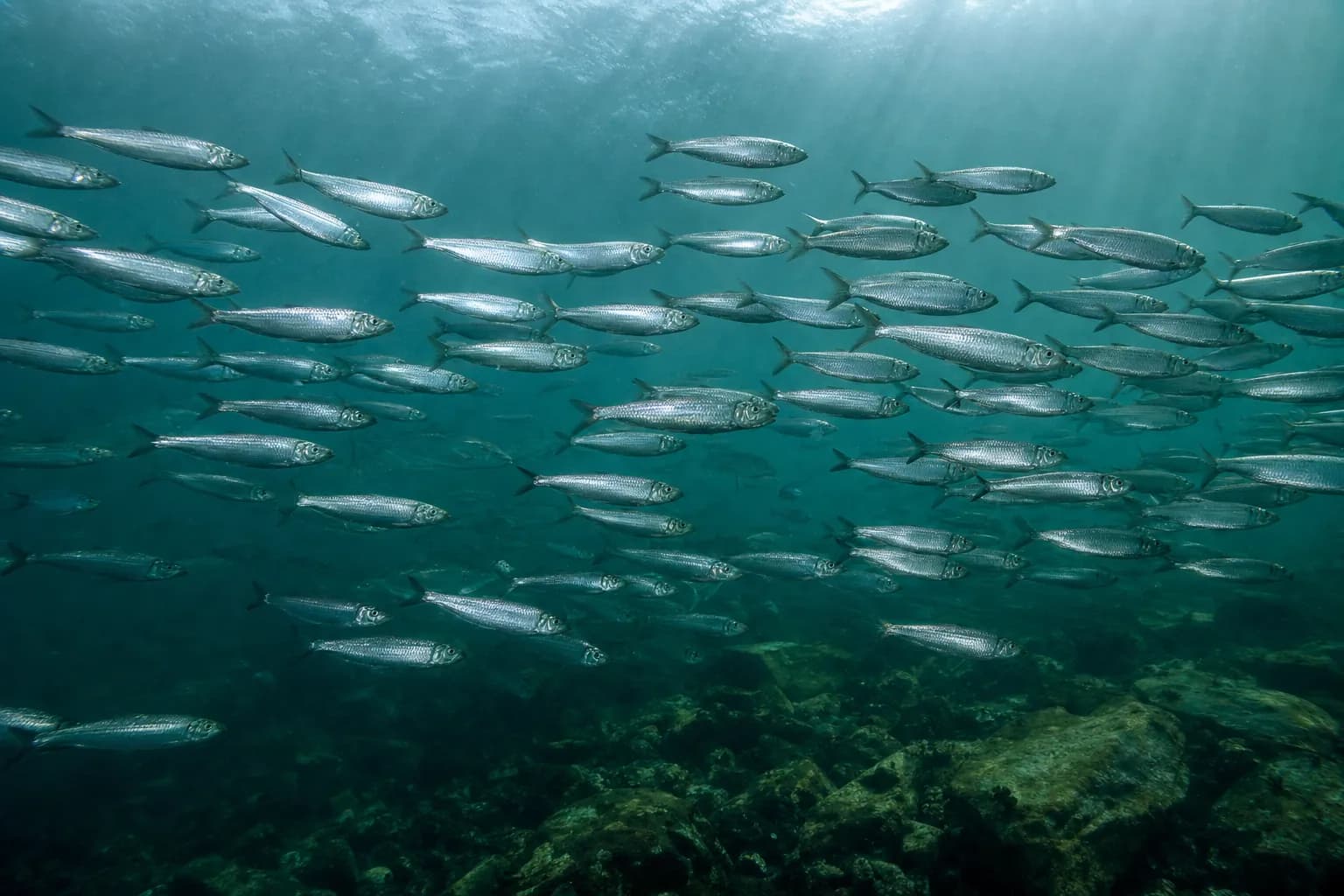
Cetoleic acid enters herring through the marine food chain. Copepods, the microscopic crustaceans that dominate cold Arctic waters, build long-chain monounsaturated wax esters as an energy store. Herring feeding on them metabolise and deposit cetoleic acid (C22:1 n-11) in their own lipid reserves.
This is why pelagic cold-water species such as Norwegian Arctic herring carry cetoleic acid at roughly 8-14% by weight, a level warm-water fish and most standard marine oils do not reach. It is a property of the source, not something added in processing.
Evidence
What the research shows.
Most published work on cetoleic acid has appeared in the last fifteen years, largely from Norwegian institutions including the University of Bergen and Nofima. The findings below are promising but early: most are cell-culture or animal studies, with one small human pilot. None establishes a health benefit in humans, and cetoleic acid has no EFSA-authorised health claim. Each finding is reported with its study type.
Cell-culture, in vitro (human HepG2 + salmon)
Cetoleic acid increased the cells' conversion of alpha-linolenic acid (ALA) into EPA and DHA, raising the efficiency of the body's own omega-3 synthesis pathway by approximately 40% in human HepG2 liver-cell cultures.
Ostbye et al., British Journal of Nutrition, 2019 ↗Systematic review and meta-analysis (rodent studies)
Across 12 controlled rodent feeding studies (288 animals), fish oils rich in cetoleic acid lowered circulating total cholesterol by a mean of about 0.65 mmol/L, roughly 16%, versus control diets.
Mjaatveit, Oldernes and Gudbrandsen, British Journal of Nutrition, 2023 ↗Controlled animal study (rats, 10 weeks)
Rats fed herring oil rich in cetoleic acid showed about 55% lower plasma triglycerides and 45% lower LDL cholesterol than controls, alongside changes in fatty-acid composition and markers of reduced inflammation. An animal study, not a human trial.
Nundal et al., Frontiers in Nutrition, 2025 ↗Pilot randomised controlled trial (28 women, 3 months)
In a double-blind, placebo-controlled pilot, 28 healthy women took a cetoleic-acid-rich oil daily for three months. Their omega-3 index rose from 6.85% to 8.93% - a gain comparable to oils with far higher omega-3 content - while the placebo group stayed flat. The same trial also recorded reduced facial skin redness versus placebo. A preliminary human pilot, not a confirmatory trial.
Mildenberger et al., Prostaglandins, Leukotrienes and Essential Fatty Acids, 2024 (NCT05128240) ↗
How we cite this
Emerging research, framed honestly.
Cetoleic acid has no European Food Safety Authority authorised health claim. The studies above are peer-reviewed work by independent researchers, summarised here as the scientific context for our herring oil's fatty-acid profile, not as product claims. Research suggests; it does not prove. Health claims on a finished supplement are the brand owner's regulatory responsibility.
Supply
What it means for supplement brands.
For brands, cetoleic acid is a differentiation story only now becoming available: a naturally occurring Norwegian-herring fatty acid, distinct from the saturated EPA/DHA market and backed by a growing body of independent research. Arctic Nutra supplies refined Norwegian herring oil in bulk, with cetoleic acid content and full oxidation and contaminant data reported per lot.